
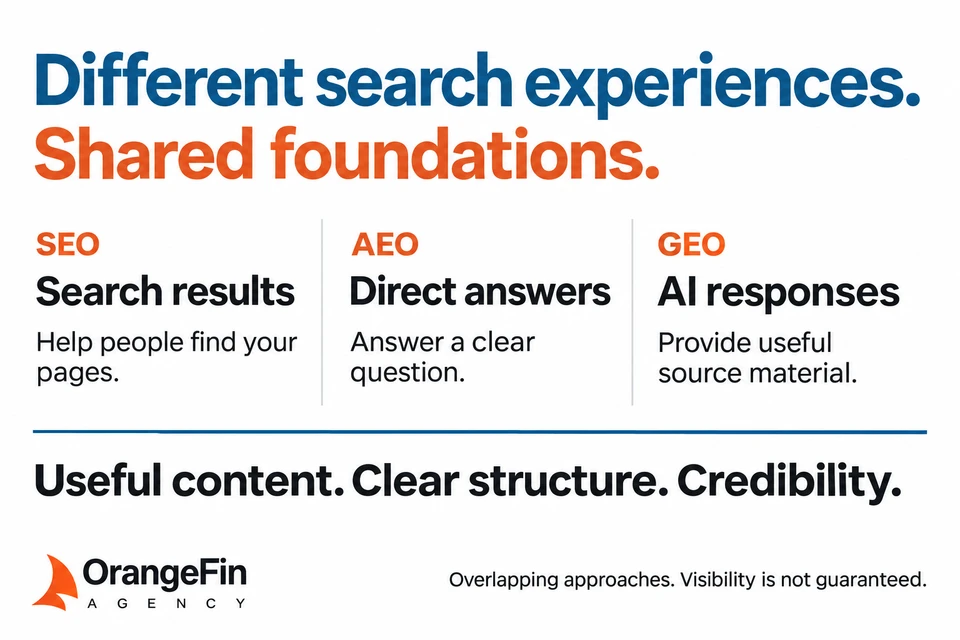
SEO, AEO, GEO. We have become very efficient at inventing acronyms. Helping customers find useful information still requires a little more work.
The way people search is changing. Some compare links. Some want a direct answer. Others ask an AI tool to explain their options. For a business trying to be found, the starting point remains remarkably familiar: publish relevant information that genuinely helps someone make a decision.
Three acronyms and one fairly sensible goal
SEO means search engine optimization. It is the work of helping search engines discover and understand your pages, and improving their usefulness for relevant searches.
AEO means answer engine optimization. It focuses on making information clear enough to answer a specific question, whether that answer appears in a search feature or another answer-driven experience.
GEO means generative engine optimization. It describes efforts to make content useful and discoverable in AI-generated responses, including responses that link to supporting sources.
These approaches overlap. They are not three separate websites, three guaranteed placements or a reason to rewrite every service page before lunch. Google's guidance says the fundamentals of SEO still apply to its AI search features. There is no special AI schema required.
What information gain actually means
In content strategy, information gain is the useful new understanding a reader gets from your page beyond what they already knew or could easily find elsewhere. It might be an original observation, a worked example, a practical comparison or a limitation that helps them avoid a poor choice.
It does not have to be a groundbreaking discovery. Sometimes the most useful thing your company can publish is the answer your technical team gives customers every Tuesday.
Consider a fictional equipment supplier. A page saying its pumps are reliable, efficient and high quality adds very little. We can probably assume the supplier was not planning to advertise the opposite.
A stronger page explains which operating conditions suit each pump, what information is needed to size it, and when a buyer should ask for technical advice. A comparison based on verified product specifications helps the reader make a decision. Adding an approved example from actual work would make it stronger still.
That is information gain: less uncertainty for the customer, rather than more words for the website.
We are using the term as a content principle, not claiming Google assigns every page a publicly confirmed “information gain score.” Google does explicitly ask whether content offers original information and substantial value beyond other pages. That is a useful standard to work towards.
Three pillars that are more useful than keyword stuffing
Our approach starts with consistency, relevance and information gain. These are practical priorities, not three official ranking factors with percentages conveniently attached.
Repeating a keyword in every second sentence does not make an answer better. Neither does adding a list of twenty towns to a page that says nothing useful about serving any of them. A map is allowed to have that many place names. Your opening paragraph probably does not need them.
Google identifies manipulative keyword stuffing, including blocks of cities and regions, as spam. Bing also warns against keyword stuffing and language engineered to manipulate rankings or AI responses. Genuine location information is useful when it explains where you work, what is available there or what a local customer needs to know.
Consistency means your website, social profiles and customer-facing content tell the same accurate story. It also means maintaining the site: current information, working HTTPS and sensible security upkeep. This is dependable business practice, not a claim that social activity or a security checklist automatically improves rankings.
Relevance means answering the question the right customer is actually asking. Information gain means leaving them better informed than they were before they arrived.
At OrangeFin, making sure your website contains relevant, useful information will always be our first priority when working to improve keyword rankings. The question is not simply which keyword we can fit into a heading. It is what the person searching needs to understand next.
Someone researching a service may need to know who it is for, what affects the cost, what the process involves and where it may not be the right fit. Answer those questions with specifics your team can stand behind.
Relevance is not a ranking guarantee. Competition, technical accessibility and other signals matter too. But a technically polished page that avoids the customer's question is still avoiding the customer's question.
AI does not remove the need for something worth saying
Google does not treat content as a violation simply because AI helped write it. Its current guidance on generative AI content emphasizes accuracy, quality and relevance. The issue is quality and purpose. Its policies address scaled content created to manipulate rankings without helping people. Bing likewise warns about large-scale generation without oversight, quality control or editorial review.
AI can help organize your team's knowledge and produce a first draft. It cannot turn a rearrangement of everyone else's articles into your company's experience. Someone still needs to supply the insight, check the facts and decide what deserves to be published.
The technical work still matters
The principles are simple. Applying them well takes judgement: choosing the right questions, finding reliable evidence, structuring the answers and diagnosing what prevents people from finding them. Useful content also needs a website that makes it easy to find and understand. Here are a few checks worth doing properly.
Check whether the right pages can be discovered. Review crawl access, accidental noindex directives, broken links and sitemap coverage. Confirm that important pages are reachable through ordinary internal links. A sitemap is helpful; it does not guarantee indexing.
Give each page a clear job. Use a descriptive title, a clear main heading and subheadings that follow the reader's questions. Keep important answers available as text, rather than hiding them inside a graphic. Link to the relevant service, product or next step.
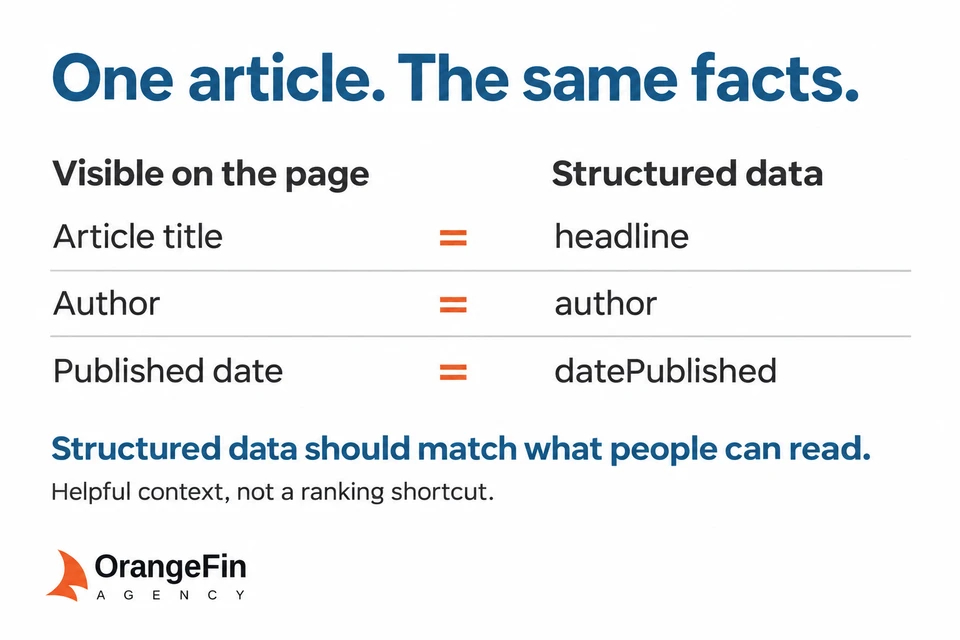
Keep structured data honest. Structured data is machine-readable information that helps describe a page. On an article, that can include its headline, author and publication date. Those details should agree with what visitors can see. Markup is not a substitute for useful content or a promise of a richer search result.
Separate search access from AI training choices. OpenAI's OAI-SearchBot is used for ChatGPT search; GPTBot relates to model training. Those controls are independent. If ChatGPT search visibility is a goal, review the appropriate crawler access and hosting restrictions. Allowing access does not guarantee a citation.
Make the page work well for people. Optimize images, keep the mobile layout readable and check loading, responsiveness and unexpected layout movement. Then measure relevant search traffic and useful enquiries, not just an isolated keyword position.
Earn attention and use paid search with a purpose
Useful, topical material can give relevant publications, industry partners and other credible websites a reason to link to you. Those earned backlinks can help people discover your work and contribute signals search engines use to understand it. Publishing a good article does not automatically earn links or guarantee a ranking. Buying a collection of unrelated links is not the same strategy.
Paid search can complement that organic work by putting an offer in front of people searching for it. It operates through a separate ad auction; buying ads does not directly improve your organic rankings. The right mix depends on your goals, competition, budget and ability to turn an enquiry into business. OrangeFin can help with both the organic content strategy and paid search, including the pages people reach after they click.
Consistency does not mean publishing for the sake of it
Start with the questions your customers actually ask. Give someone responsibility for checking the answers. Update the page when products, processes or advice change, and use what you learn from enquiries to improve it.
A useful page kept accurate is a better investment than a weekly article whose main achievement is being weekly.
Look, SEO, AEO, GEO: the terms are simple enough. The idea can seem complex. It really comes down to consistency, relevance and proper structure, all things we can help you do.
If you want to make your expertise easier to find and more useful to the people looking for it, reach out to OrangeFin. Happy to discuss this more.