
You need a product launch, a better way to handle enquiries and a website that does more than confirm you have a website. You may not need the same person working on all three, forty hours a week, indefinitely.
Yet that is often how we frame the decision: add another employee, give the existing team more work, or wait until everyone has a little spare time. The third option has an impressive record of producing next year’s priorities.
AI is changing the work businesses need done, how quickly parts of it can happen and where experienced judgement matters most. For manufacturers and distributors, that makes a different question worth asking: what expertise do we need for this next stage, and for how long?
In our earlier article, Fractional Marketing in the Age of AI, we looked at why experienced marketing judgement still matters as production gets faster. The next question is how to turn that expertise into a defined piece of work that gets finished.
Read: Fractional Marketing in the Age of AI
The financial opportunity is real for some businesses, but uneven. McKinsey’s 2026 global survey found that 37 per cent of respondents reported a positive AI contribution to earnings before interest and taxes. That supports taking the opportunity seriously, not assuming that every project will pay for itself. Experienced judgement is needed to choose the work, set its limits and measure whether it helped.
Source: McKinsey’s 2026 global AI survey
Buy the expertise the work calls for
Full-time employees bring continuity, company knowledge and ready access to someone who understands the business. Those are real advantages. A permanent role makes sense when the responsibility is substantial and ongoing.
But a business may need senior marketing direction for a few days each month, a specialist to build a product selector, or an experienced team to get a campaign launched. Those are different requirements. They do not automatically add up to three permanent jobs.
Fractional marketing leadership gives you a defined share of an experienced person’s time and responsibility. Project consulting brings expertise to a specific outcome. They can work together: maintain direction while bringing in the right skills for each build, then reallocate resources as priorities change.
This is a way to organize the work, not a prediction that manufacturers and distributors will stop hiring employees. A focused engagement can sit alongside your existing team, with the internal knowledge staying where it belongs.
For an individual business, the decision is more practical than a trend report: do you need permanent capacity, specialist help for a defined project, or a combination?
A launch needed more than a website
A recent client came to OrangeFin with a connected set of needs: develop the brand, build the website, bring third-party software into the customer experience and get the digital work ready around a business launch.
The owner knew what they did not know. They could spend their launch period learning how to coordinate design, website development and software integration, or stay focused on running the business and bring in people who already did that work. Starting a business apparently did not leave enough spare time for a second career in web development.
OrangeFin handled the strategy, planning and execution across the brand, website and integration. The delivered work included the website and its content, logo and brand guidelines, connected booking and forms, and professional email setup. Search visibility work formed part of establishing the digital presence. Those are delivery milestones, not claims of rankings, AI recommendations or additional revenue.
Connect the customer journey, not just the software
The practical integration used the third-party booking experience embedded within the website. The site explained the services and gave visitors a route into that booking experience, rather than requiring the business to replace its booking platform.
That distinction matters. An embedded service can make a journey easier to follow without turning the website and the external system into one database. Website wording and prices may still need separate updates when the booking system changes. A click into booking is not proof that someone completed a booking.
The supporting reference guide addressed everyday tasks such as changing prices, adjusting availability and checking the public result, including when the website needed a corresponding update. That makes the boundary understandable for the person who has to run the business after the build.
For your own project, settle those boundaries before agreeing the launch scope. Which system owns the information? Where does the customer move from browsing to taking action? What needs updating in two places? Who checks the public result? “It integrates” is a reassuring sentence with a surprisingly large amount of room inside it.
Finish the launch scope. Keep the next phase optional.
The client could concentrate on the business while OrangeFin worked through the digital requirements. The business is now up and running. New programs can follow when the client is ready, with the scope, timing and investment agreed around that next need.
The launch phase and ongoing care are different responsibilities. Hosting, security and routine upkeep still need an owner. Larger growth programs do not have to begin simply because the website is live. A good plan makes the next step possible without making every future step due immediately.
That is the value of focused consultancy: access to the expertise and delivery capacity a business needs for a particular stage, followed by a deliberate decision about what comes next.
Write a brief that can actually be finished
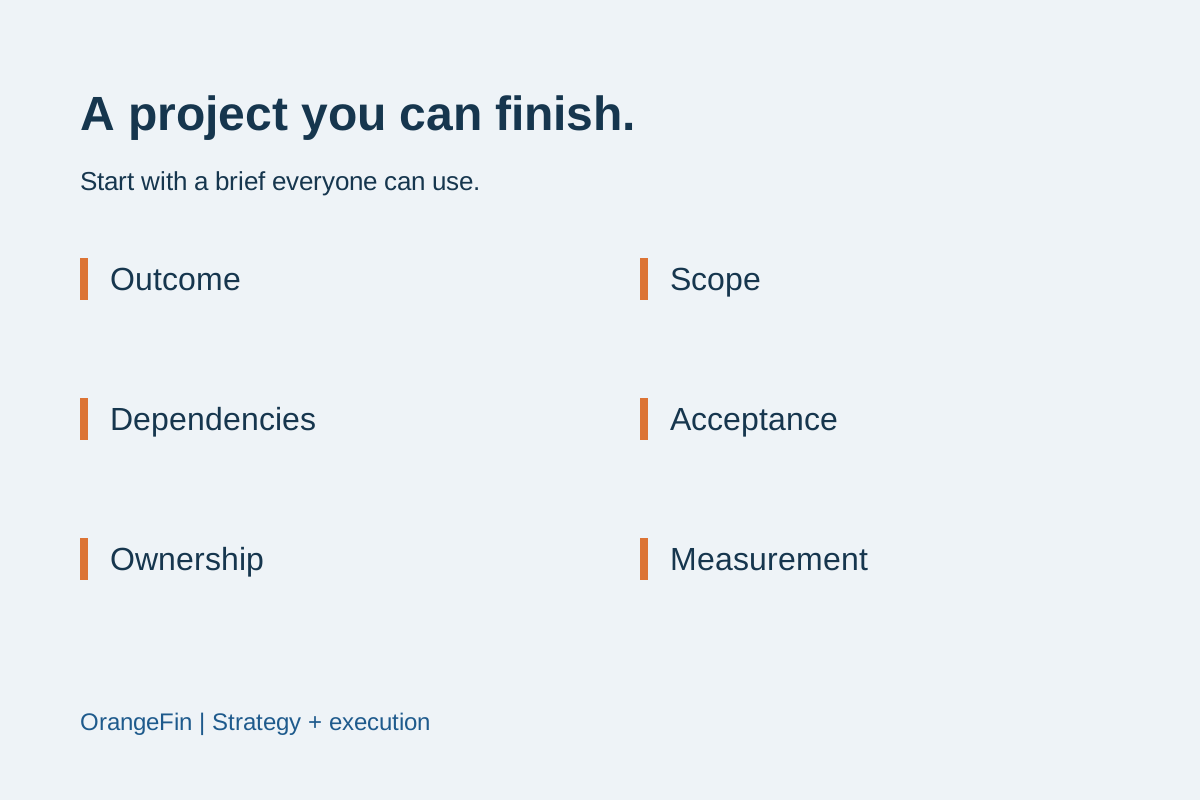
Before bringing in a consultant, put these six things on one page. They are useful whether your next project is a launch, a distributor portal or a campaign:
Business outcome: what should customers or your team be able to do when this is finished?
Launch scope: which pages, assets, integrations and workflows are included, and what can wait?
Dependencies: which approvals, account access, content and third-party capabilities must be ready?
Acceptance: what will you test, who approves it, and what evidence shows the agreed work is complete?
Ownership: who maintains each system and its information after handover, and what support remains?
Measurement and next phase: what baseline will you use, when will you review it, and what would justify another project?
For a booking journey, test the route and verify actual confirmations separately from clicks. For a quotation tool, compare complete enquiries and time spent gathering missing details against the starting point. Revenue is a later business outcome to establish, not a number to attach to a successful launch screenshot.
Scalability needs something that keeps working
Scalability is a pleasing word. It becomes more useful once someone explains what will be built.
For manufacturers and distributors, the work OrangeFin can plan and execute includes:
Campaigns and product launches: sharpen the positioning, build the landing pages and sales materials, and connect enquiries to an agreed next step.
Customer and distributor programs: organize product resources, training materials and sales tools so the same questions do not require the same manual search every week.
Product selectors, configurators and calculators: help buyers narrow their options using approved product data, compatibility rules and clear assumptions.
Websites and search content: answer the questions buyers actually ask, make technical information easier to find and give visitors a useful route to an enquiry.
Workflow automation and integrations: connect forms, information and internal handoffs, with someone responsible for exceptions rather than hoping the software has developed initiative.
Practical AI tools: make approved product information easier to retrieve, with access controls, maintained sources and a clear route to a human when an answer needs checking.
Measurement and improvement: track qualified enquiries, completed tools and quote requests, then use what happens to prioritize the next change.
The right combination depends on the business. A product selector will not fix unclear positioning. A new campaign will not repair a broken enquiry handoff. Sometimes the best technology decision is to simplify the process before adding anything to it.
The consultant should help make it happen
There is an old consulting joke: pay someone a considerable amount to tell you to increase revenue and reduce expenses.
An excellent recommendation. We had been considering the reverse.
Those are still worthwhile outcomes. The problem is stopping at the recommendation, leaving the client with a presentation and another project to manage.
At OrangeFin, consultancy combines expertise and strategic thinking with the ability to execute. We help define the business problem, prioritize the work, then build and implement the agreed solution. Marketing, websites, applications and practical AI can sit in the same plan because the customer’s problem rarely respects departmental boundaries.
The scope should also say who owns the work after launch. Fractional does not mean vaguely available. Agree on responsibilities, working time, decisions, measures and handover. If a system needs maintenance or a campaign needs ongoing attention, plan for that before moving the budget elsewhere.
Start with the next business need
Before writing another job description or buying another AI subscription, choose one problem that is holding the business back. Define the outcome, identify the missing expertise and decide how long you need it. Compare the total cost of a permanent hire, a focused project and fractional support, including your own team’s time.
Then measure what changes. More output is useful only if it helps the customer or the business. Increased revenue and reduced expenses remain the ambition; neither arrives automatically with a new tool or an impressive title.
AI is changing business needs. Is the way you bring in expertise changing with them?
If your next priority needs experienced marketing direction and someone who can help deliver it, let’s talk about the work.