
Marketing is getting easier to execute.
That does not mean marketing itself is getting easier.
AI has already changed how quickly we can create copy, images, presentations, campaign ideas, social content, emails and even working websites. That is only going to continue.
A lot of work that used to take days can now take hours, and in some cases minutes.
McKinsey recently described this shift pretty clearly. Campaign cycles that once took six to ten weeks can increasingly move toward same-day execution, while content production that used to take days can happen in minutes or hours.
That is a pretty big change.
But creating the work was never the whole job.
The harder questions are still there.
What should we create?
Who are we trying to reach?
Where should we be spending money?
What is actually working?
Where are customers getting frustrated or dropping off?
What technology should we be using?
What should we automate?
Just because we can use AI here, does that mean we should?
Those are very different questions from writing an email or creating an ad.
They require context, experience and judgment.
And I think that is where the role of marketing is starting to change.
Execution Is Getting Faster
A lot of marketing teams have traditionally been built around the amount of work required to get things out the door.
Someone had to write the copy.
Someone had to resize the creative.
Someone had to build the email.
Someone had to create the landing page.
Someone had to summarize the research.
Someone had to create multiple versions of an ad.
Someone had to pull together the report.
Those jobs still exist, but the amount of time required to do them is changing fast.
BCG has reported clients seeing up to a tenfold increase in content volume through generative AI, along with meaningful reductions in production-related costs.
The more interesting part is what happens next.
If the team can produce the work faster, it has more room to test, adapt, personalize and execute across more channels.
That is where the opportunity is.
AI gives marketing teams more capacity.
The real question is how that capacity gets used.
The Marketing Team Is Changing
This is where I think things get interesting, especially for small and mid-sized companies.
There will always be organizations that need large internal marketing teams.
But there are also a lot of companies where the traditional structure is starting to make less sense.
A business may not need a senior marketing leader spending every day managing content production.
But it may absolutely need someone regularly asking:
Are we focused on the right market?
Does the website actually match how customers buy?
Why are good prospects leaving this page?
Should this process be automated?
Are we tracking the right things?
Should we be putting more into search, email, social, content or something else?
Could a customer solve this problem themselves online?
Is this AI tool actually making the customer experience better?
Are sales and marketing working from the same information?
What did we learn from the last few months, and what should change next?
Those are not once-a-year questions.
They are ongoing questions.
And as execution gets faster, I think they become even more important.
AI Makes Judgment More Important, Not Less
Harvard Business Review has made a similar point when looking at how generative AI should fit into marketing strategy.
Organizations still need to decide where automation makes sense, where personalization is useful, which tools are appropriate and how much human oversight is required.
That part matters.
Using AI is getting easy.
Using it well is harder.
A company can automate customer communication.
Should it?
A company can generate hundreds of pieces of content.
Where should that content be focused?
A company can add an AI assistant to its website.
What problem is it actually solving?
A company can personalize a customer experience.
Which information should it use, and where does that personalization genuinely help?
The technology can move very quickly.
The objective still has to be clear.
The Customer Journey Still Has to Be the Reference Point
This is probably the part I come back to most.
Technology can become the project if you let it.
I think that is where companies can get off track.
The customer still has to be the reference point.
Take a distributor's website.
Can they find the product?
Can they understand it?
Can they compare it?
Can they see their price?
Can they figure out if it works for their application?
Can they find the accessories they need?
Can they check availability?
Can they order it or request a quote?
And if they get stuck, can they reach the right person without starting all over again?
That is really what matters.
AI might improve search.
Automation might improve follow-up.
A recommendation tool might make product selection easier.
Better analytics might show where customers are leaving.
A CRM connection might give a salesperson the information they need to continue the conversation properly.
All of those things can help.
But only if they make the experience easier and move the customer forward.
Analysis Is Becoming Part of the Day-to-Day
Marketing also used to operate in fairly clear cycles.
That cycle is getting shorter.
McKinsey describes marketing moving toward more continuous systems, where teams use real-time information, automation and AI to keep adjusting what they are doing.
That makes analysis more important.
It is not enough to know that something happened last month.
The better question is:
Why did it happen, and what do we change now?
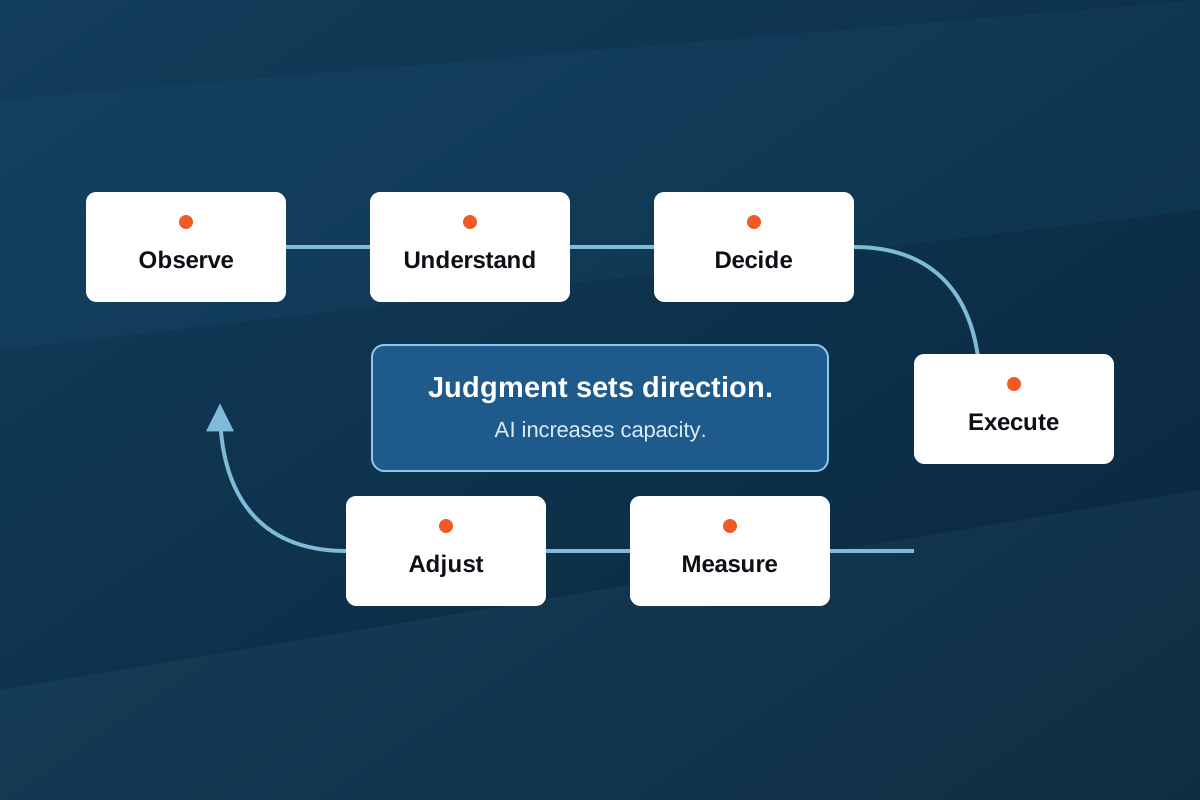
The marketing process starts to look more like:
AI can help with every one of those steps.
But someone still has to connect them.
The Future Marketing Team May Look Different
I do not think the future is a marketing department with no people and a collection of AI agents doing everything.
I also do not think it looks exactly like the marketing department of ten years ago.
It is probably somewhere in the middle.
- Internal people who understand the company and its customers.
- Specialists who come in when their expertise is needed.
- Fractional leadership that helps with direction, priorities and decision-making.
- Technology that connects systems and customer interactions.
- AI that makes research, production, analysis and execution faster.
- People deciding where all of those pieces should actually be used.
The mix will be different for every company.
That is probably the point.
Where This Is Going
AI will keep making marketing execution faster and easier to deploy.
What it does not remove is the need to understand the customer, make good decisions, assess what is working and decide where technology should and should not be used.
For a lot of companies, that may change what they need from a marketing team.
Less focus on managing every individual task.
More focus on direction, analysis, technology, execution and making sure the customer journey keeps moving toward conversion.
That is where I think fractional marketing becomes increasingly relevant.